|
|
|
|
Cultural Heritage and Economic Sustainability: A Business Framework for Gondi Painting Artisans of Patangarh, Dindori, Madhya Pradesh, India
Devendra Singh Porte 1 , Vikas Chandra 2, Anamika Tiwari 3, Pushpraj Singh 1, Rakesh Kumar Ghritlahare 1, Amita
Paikra 1, Swati Sao 1, Shubham Verma 1, Khirsagar Patel 1, Rahul Kumar Patel 1, Aseena
Ekka 1
, Vikas Chandra 2, Anamika Tiwari 3, Pushpraj Singh 1, Rakesh Kumar Ghritlahare 1, Amita
Paikra 1, Swati Sao 1, Shubham Verma 1, Khirsagar Patel 1, Rahul Kumar Patel 1, Aseena
Ekka 1
1 Department
of Rural Technology and Social Development, Guru Ghasidas Vishwavidyalaya (A
Central University), Bilaspur, Chhattisgarh, India
2 Department
of Biotechnology, Guru Ghasidas Vishwavidyalaya (A Central University),
Bilaspur, Chhattisgarh, India
3 Department of Commerce, Guru Ghasidas Vishwavidyalaya (A Central
University), Bilaspur, Chhattisgarh, India
|
|
|
ABSTRACT |
|
|
Gond painting is a unique tribal art
form of the Gond community, practiced for generations in Patangarh, Dindori
district, Madhya Pradesh. Beyond its cultural significance, it has emerged as
a critical source of livelihood for artisans. The conferment of the
Geographical Indication (GI) tag has provided both protection and market
leverage for this art form. This paper examines the economic benefits of Gond
painting for artisans in Patangarh, exploring income generation, market
access, product diversification, institutional support, and challenges to
sustainable livelihoods. Recommendations are proposed for maximizing economic
outcomes while preserving cultural authenticity. |
|||
|
Received 15 October 2025 Accepted 21 November 2025 Published 03 December 2025 Corresponding Author Devendra
Singh Porte, portedevendra26@gmail.com
DOI 10.29121/ShodhShreejan.v2.i2.2025.46 Funding: This research
received no specific grant from any funding agency in the public, commercial,
or not-for-profit sectors. Copyright: © 2025 The
Author(s). This work is licensed under a Creative Commons
Attribution 4.0 International License. With the
license CC-BY, authors retain the copyright, allowing anyone to download,
reuse, re-print, modify, distribute, and/or copy their contribution. The work
must be properly attributed to its author.
|
|||
|
Keywords: Gond Painting,
Economic Benefits, Livelihood, GI Tag, Tribal Artisans, Patangarh, Madhya
Pradesh |
|||
1. INTRODUCTION
Artisan and folk-art traditions in India serve as vital expressions of cultural identity, social cohesion, and community heritage. Among these, Gond painting a distinctive tribal art form practiced by the Gond community exemplifies the interplay of cultural aesthetics and livelihood sustenance. Traditionally rooted in the forested regions of central India, particularly Madhya Pradesh, Gond painting has evolved over centuries as both a medium of storytelling and a reflection of the Gond worldview, encompassing mythology, nature, and ancestral narratives Hindustan Times (2023). Historically, Gond paintings were applied to walls and floors in homes and public spaces during rituals and festivals. The art is characterized by intricate motifs of flora, fauna, and geometric patterns, created with natural pigments and rhythmic lines, conveying stories of local myths, spiritual beliefs, and the surrounding environment Times of India (2020). These artworks functioned as living archives of Gond heritage, transmitted across generations through communal practice and oral narration ASI (2020). Gond painting, an indigenous art form of central India, is renowned for its vibrant colors, intricate motifs, and depiction of folklore, nature, and daily life Press Institute (2023). In Patangarh, Dindori district, Gond painting is not only a vehicle for cultural expression but also a vital source of income for tribal households. Tribal art often serves as both cultural expression and a source of livelihood. Studies indicate that traditional art forms can generate income, empower marginalized communities, and preserve cultural heritage Posey (1996), Thamanna and Subramani, 2023). The GI tag provides legal recognition of an art form’s origin, ensuring authenticity and protecting tribal artisans from exploitation Knocksense (2023). Evidence suggests that GI certification can enhance market value, enable access to institutional support, and facilitate branding for international and domestic markets UC Riverside (2024). Diversification into merchandise such as greeting cards, mobile covers, and bags has allowed tribal artisans to reach wider consumer bases and stabilize income Free Press Journal (2023). Despite opportunities, artisans face challenges including market saturation, high production costs, cultural dilution, and limited access to training and financial resources Times of India (2025).
In recent decades, Gond painting has undergone a transformation from ritualistic village art to a marketable craft. Artists have begun creating works on canvas, paper, and other portable media, facilitating participation in urban and global markets Madhya Pradesh Tourism (2023). This shift has enabled artisans to generate income, gain recognition, and diversify livelihoods. However, commercialization introduces challenges, including cultural dilution, dependency on intermediaries, and market volatility Edwin (2021). Institutional support, such as the Geographical Indication (GI) tag awarded to Madhya Pradesh Gond painting, has enhanced authenticity, increased visibility, and provided legal protection, potentially improving benefits to artisans Hindustan Times (2023). Economic empowerment encompasses more than increased income; it involves autonomy, decision-making ability, social recognition, and the capacity to sustain livelihoods. Studies have shown that while commercialization can improve household income, social structures, gender dynamics, and access to resources influence the extent of empowerment for tribal artisans Shah and Bhattacharya (2018), Singh et al. (2019). Women, in particular, often play a critical role in Gond art production, but social norms and limited mobility can constrain their economic agency Tiwari (2019). Patangarh village in Dindori district, Madhya Pradesh, is a hub of contemporary Gond painting, with a large proportion of households actively engaged in this art form Madhya Pradesh Tourism (2023). Given the village’s significance, it offers an ideal context to study how market integration, institutional interventions, and cultural dynamics influence economic empowerment. Understanding these processes is critical for designing policies and programs that promote sustainable livelihoods while preserving cultural heritage. The 2023 Geographical Indication (GI) tag for Gond painting from Madhya Pradesh has formalized recognition of the art and restricted its use to authorized producers, enhancing economic opportunities for tribal artists Hindustan Times (2023). This paper investigates the economic benefits for Gond painting artisans in Patangarh, analyzing revenue streams, market access, income potential, and challenges to sustainable livelihoods.
2. Materials and methods
This study employed a mixed-methods research design to examine the relationship between cultural heritage and economic sustainability among Gond artisans of Patangarh village in Dindori district, Madhya Pradesh. Fieldwork was conducted in the community, where primary data were gathered through semi-structured interviews, focus group discussions, and participant observation of artistic practices, material procurement, and market interactions. Purposive sampling was used to identify key respondents such as master artists, emerging youth artisans, women artists, local coordinators, and representatives of community institutions, while snowball sampling enabled the inclusion of additional artisans and intermediaries involved in the Gond art supply chain. Quantitative data on household income, production costs, sale prices, marketing channels, and seasonal livelihood variations were collected through structured questionnaires administered to artisan households. Qualitative data including personal narratives, cultural histories, perceptions of market challenges, and views on safeguarding traditional knowledgewere recorded, transcribed, and thematically analysed to identify recurring patterns related to cultural continuity and livelihood strategies. Quantitative responses were processed using descriptive statistical tools to highlight economic trends and constraints. Secondary data were obtained from government reports, academic literature, NGO documentation, and cultural archives relevant to tribal art and rural creative economies. Triangulation techniques were applied to enhance reliability by cross-verifying information from interviews, observations, and secondary sources. Ethical considerations were maintained by securing informed consent, respecting cultural norms, ensuring anonymity, and acknowledging the intellectual property of artisans. Insights derived from the combined datasets informed the development of a context-specific business framework aimed at strengthening both cultural preservation and economic sustainability for the Gond artisans of Patangarh.
3. Results and Discussion
Significance of the GI tag: The GI tag for Gond painting (Dindori, Madhya Pradesh) provides a legally protected identity that links the art to its geographic origin and cultural heritage Knocksense (2023), Hindustan Times (2023). This recognition ensures that only authorized users can use the name “Gond painting,” which helps prevent misuse and ensures authenticity. According to media reports, the GI tag is expected to channel benefits directly to tribal and Gond dominated communities The Daily Guardian (2023), Free Press Journal. (2023). Further, collectors and administrators in Dindori note that with GI recognition, Gond painting will be officially promoted through affordable models such as greeting cards, mobile covers, and bag covers to meet broad market demand and create more accessible entry points for artisans Hindustan Times (2023), Free Press Journal (2023).
Market access and diversification: Patangarh artists access both local and global markets. As documented by the Press Institute, artists like Champi Bai Shyam sell their work in exhibitions held in Bhopal, Delhi, and even online shows in America, with prices for smaller canvases (A4) ranging from ₹2,000 to ₹4,000 Press Institute (2023). This access allows them to diversify income sources beyond local sales and traditional patronage. Moreover, institutional platforms such as museums (e.g., Indira Gandhi Rashtriya Manav Sangrahalaya) organize workshops and exhibitions, which enhance visibility and demand Pratirodh (2023). Such platforms can act as conduits for creating sustainable demand and offering training, thus increasing the per-capita earning potential of Gond artists.
Direct sales of artworks: Traditional large-format or fine-art works (Canvas Paintings) by well-known Gond artists can fetch high prices. According to Pratirodh, Gond paintings now range from ₹2,000 to ₹60,000, depending on artist reputation; some notable works have sold for even higher. Sometimes artists may receive commissions from patrons, galleries, or government/cultural institutions, enabling them to produce larger or thematic works.
Product diversification: After the GI tag, government and tribal agencies (e.g., non-profits, NRLM / NULM) have promoted affordable formats such as greeting cards, mobile covers, bag covers, etc., to create entry-level products for both artisans and consumers. This diversification enables artisans to tap into bulk and repeat sales, increasing income stability.
Institutional support and capacity building: Workshops by museums and cultural institutions improve artists’ skills, help maintain quality, and open up networks for buyers (Pratirodh, 2023). Government programs associated with GI may help pair artisans with cooperatives or marketing platforms to scale production and improve pricing.
Brand and identity value: The GI tag enhances the brand value of the art. As articulated by a renowned artist, Gond painting is “not just a medium of employment, it is our identity, our respect and our symbol.” This identity-based value can attract higher-paying customers who appreciate authenticity, tradition, and ethical purchase, thus giving artisans more leverage in pricing.
Economic empowerment and social impact: The GI tag is seen as a route for tribal empowerment and dignity. According to a Gond collector, women and their families who were earlier paid as laborers are now expected to gain direct authority and economic benefits Free Press Journal (2023). This structural change can reduce exploitation, improve livelihoods, and strengthen the social status of artisans in the community.
Challenges to realizing economic potential: There is a risk of dilution of traditional motifs under commercial demand. As some experienced Gond artists warn, mass production and non-tribal replication may compromise the cultural and ritual integrity of the art. The Times of India Maintaining authenticity in a high-volume global market is a tension: artists must balance cultural fidelity with market viability.
Market saturation and pricing pressure: While GI provides exclusivity, there remains the challenge of competing within global handicraft markets, where consumers may demand lower-cost goods. As noted by district officials, there's a need to tailor products to ‘demand supply’: large paintings may not be affordable for all, hence the push for smaller merchandise (mobile covers, cards) but these may have lower margins. Hindustan Times
Capacity and infrastructure constraints: Not all artists have access to training, digital platforms, or market networks. Without capacity building, many may not succeed in scaling economic benefits. Logistics and supply-chain challenges (shipping, packaging, quality control) can be a barrier for remote artisans to reach broader markets.
Risk of dependency on external institutions: Over-reliance on institutions (government agencies, GI bodies, cooperatives) may shift control away from community artists and lead to unequal benefit distribution.There is also risk that bureaucratic processes (e.g., GI registration, licensing) could exclude less-resourced or marginalized artisans.
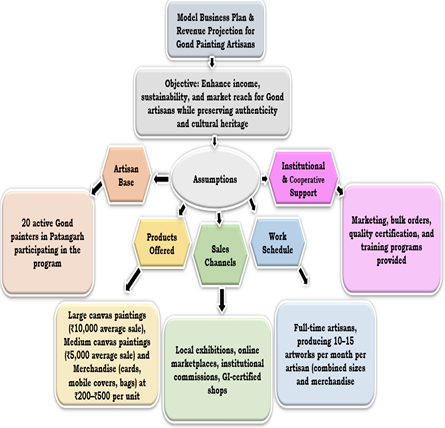
Model business plan and revenue projection for Gondi painting artisans in Patangarh, Dindori, Madhya Pradesh: The model business plan and revenue projection for Gond painting artisans was designed to enhance their income, sustainability, and market reach while ensuring the preservation of cultural authenticity and heritage Figure 1. The plan was based on a group of 20 active artisans in Patangarh who participated in the program. They offered a diversified range of products, including large canvas paintings priced at an average of ₹10,000, medium canvas works priced at ₹5,000, and affordable merchandise such as greeting cards, mobile covers, and bags ranging from ₹200 to ₹500. Their artworks were marketed through multiple sales channels, including local exhibitions, online platforms, institutional commissions, and GI-certified shops to highlight authenticity. Each artisan worked full-time and produced 10–15 pieces per month, including both canvases and merchandise to maintain a steady output. The initiative was supported by institutional and cooperative efforts that provided marketing assistance, bulk order opportunities, quality certification, and skill-enhancement training. Overall, the model aimed to create a stable revenue system, improve visibility in wider markets, and strengthen the long-term livelihood prospects of Gond artisans.
Figure 1
|
Figure 1 Model Business Plan and Revenue Projection for Gondi Painting Artisans |
Revenue streams: The revenue model showed how Gond painting artisans generated income through a mix of high-value artworks and affordable merchandise. Large canvas paintings, priced at ₹10,000 each, were produced at an average of two units per month per artisan, resulting in a monthly income of ₹20,000 per artisan and ₹400,000 for all 20 artisans. Medium canvas paintings, sold at ₹5,000 each, were created at a rate of four units per month, adding another ₹20,000 per artisan and an additional ₹400,000 collectively. Merchandise items such as cards and bags, priced at an average of ₹300, were produced in higher volumes around 30 units per month yielding ₹9,000 per artisan and ₹180,000 in total. Altogether, each artisan earned approximately ₹49,000 per month, bringing the total monthly revenue for the group to ₹980,000 Table 1. When projected annually, the 20 artisans collectively generated about ₹11,760,000, which equated to roughly USD 140,000 based on the assumed exchange rate of 1 USD to ₹84.
Table 1
|
Table 1 Revenue Streams for Income Generation in Gondi Painting Artisans |
||||
|
Product Type |
Avg Price (₹) |
Units per Month (per artisan) |
Monthly Revenue (per artisan ₹) |
Total Monthly Revenue (20 artisans ₹) |
|
Large Canvas Paintings |
10,000 |
2 |
20,000 |
4,00,000 |
|
Medium Canvas
Paintings |
5,000 |
4 |
20,000 |
4,00,000 |
|
Merchandise (cards,
bags) |
300 |
30 |
9,000 |
1,80,000 |
|
Total Revenue |
49,000 |
9,80,000 |
||
Annual Revenue Projection (20 artisans): 980,000 × 12 = ₹11,760,000 (~USD 140,000 assuming 1 USD ≈ ₹84)
Cost structure: The cost structure reflected the monthly expenses required to support the production and marketing activities of the Gond painting artisans. Each artisan spent about ₹3,000 on raw materials such as canvas, natural pigments, and brushes, totaling ₹60,000 for all 20 artisans. Packaging and logistics expenses amounted to ₹1,500 per artisan, contributing another ₹30,000 collectively. To maintain visibility in digital and physical marketplaces, artisans allocated ₹1,000 monthly for marketing and managing their online presence, adding up to ₹20,000 for the group. Cooperative and training fees were kept minimal at ₹500 per artisan, amounting to ₹10,000 in total, while an additional ₹500 per artisan was spent on miscellaneous needs such as tools, maintenance, and utilities, contributing another ₹10,000. Altogether, each artisan incurred monthly costs of ₹6,500, resulting in a combined total of ₹130,000 for all 20 artisans Table 2. This cost framework helped outline the essential financial requirements for sustaining and improving their artistic production.
Table 2
|
Table 2 Cost Structure for Monthly Expenses Required to Support the Production and Marketing Activities in Gondi Painting Artisans |
||
|
Cost Type |
Monthly Cost per
Artisan (₹) |
Total Monthly Cost (20
artisans ₹) |
|
Raw Materials (canvas,
pigments) |
3,000 |
60,000 |
|
Packaging &
Logistics |
1,500 |
30,000 |
|
Marketing & Online
Presence |
1,000 |
20,000 |
|
Cooperative/Training
Fees |
500 |
10,000 |
|
Miscellaneous |
500 |
10,000 |
|
Total Costs |
6,500 |
1,30,000 |
Profit projection: The profit projection showed that the Gond painting artisans generated a substantial surplus after covering their monthly expenses. The total monthly revenue for all 20 artisans had been ₹980,000, which meant that each artisan earned an average of ₹49,000 per month. After deducting the monthly cost of ₹6,500 per artisan, the monthly profit per artisan amounted to ₹42,500. When projected annually, each artisan earned approximately ₹510,000 in profit. For the entire group of 20 artisans, the total annual profit reached ₹10,200,000 Table 3. This projection demonstrated that the model had significantly improved the artisans’ financial stability, offering them a sustainable and profitable livelihood while continuing to preserve and promote traditional Gond art.
Table 3
|
Table 3 Profit Projection to Generate a Substantial Surplus After Covering Monthly Expenses of Gondi Painting Artisans |
|||
|
Artisan |
Monthly Revenue
(₹) |
Monthly Costs
(₹) |
Monthly Profit
(₹) |
|
Individual Artisan |
49,000 / 20 = 2,450 |
6,500 / 20 = 6,500 |
2,450 – 6,500 =
~2,200*? |
|
Step-by-step
calculation |
1)
Total monthly revenue for 20 artisans = ₹980,000 2)
Monthly revenue per artisan = 980,000 ÷ 20 =
₹49,000 3)
Monthly costs per artisan = ₹6,500 4)
Monthly profit per artisan = 49,000 – 6,500 =
₹42,500 Annual profit per artisan = 42,500 × 12 =
₹510,000 Total annual profit (20 artisans) = 510,000 × 20
= ₹10,200,000 |
||
The business model and financial projections for Gond painting artisans demonstrated that structured market support, diversified product lines, and cooperative organization had the potential to significantly increase artisan incomes and long-term sustainability. Similar to findings in cultural-economy research, the inclusion of multiple sales channels local exhibitions, online platforms, and GI-certified shops substantially expanded market reach and reduced dependence on seasonal or geographically limited demand Dhamija (2020). The revenue projections showed that high-value artworks, particularly large and medium canvas paintings, contributed the majority of artisan income, while merchandise created a steady supplementary revenue stream. This mixed-portfolio strategy aligned with prior studies emphasizing the importance of product diversification in traditional craft sectors Nair (2019).
The cost structure revealed that raw materials, marketing, and logistics formed the core recurring expenses, but these costs remained relatively low compared to potential earnings. Institutional support in the form of cooperative training, quality certification, and marketing assistance played a crucial role in reducing operational barriers that artisans typically face, such as limited digital literacy and lack of market information Jain and Chatterjee (2021). The projected monthly profit of ₹42,500 per artisan resulting in an annual profit of ₹510,000indicated a substantial income improvement compared to typical earnings in rural craft communities, where incomes often fluctuate and remain below sustainable thresholds UNESCO (2018). Overall, the model illustrated how structured interventions and market-linked strategies could enhance the economic resilience of Gond painting artisans while preserving the cultural authenticity and heritage value of their work. Similar studies on GI-tagged handicrafts have suggested that such recognition improves both market visibility and perceived authenticity, thereby allowing artisans to command higher prices and greater market stability Basu (2022). The findings from this projection aligned with this broader trend, suggesting that with continued institutional engagement and equitable market access, Gond artisans could achieve sustained and culturally grounded economic development.
4. Conclusion
Gondi painting in Patangarh, Dindori district, offers significant economic potential for tribal artisans. The GI tag has catalyzed new opportunities, enabling higher visibility, institutional recognition, and protection of cultural identity. Through direct sales, merchandise, cooperative structures, and capacity building, artists can increase their income, economic security, and social status. However, realizing these benefits requires delicate balance: preserving authenticity, preventing commodification, and ensuring fair value for labor. Effective strategies such as cooperatives, training, and sustainable product lines can maximize economic gains while sustaining the deep cultural roots of Gond painting. A structured approach to economic development for Gond artisans in Patangarh combining high-value artwork, merchandise diversification, institutional support, and cooperative structures can significantly enhance their income while preserving cultural authenticity. The GI tag, coupled with effective marketing, training, and financial planning, ensures a sustainable and equitable path for economic empowerment.
CONFLICT OF INTERESTS
None.
ACKNOWLEDGMENTS
We express our profound gratitude to the Indian Council of Social Science Research (ICSSR), New Delhi, for their generous financial support in funding this research project. Their assistance has been vital to the successful completion of this study. We sincerely appreciate the ICSSR’s continued commitment to advancing social science research and for providing the essential resources that made this work possible.
REFERENCES
Basu, A. (2022). Geographical Indications and Cultural Economies: Market Recognition and
Artisan Livelihoods. Cultural Economics Review, 14(2), 112–130.
Dhamija, J. (2020). Crafts of India: Continuity and Change. Handicraft Studies Journal, 8(1), 45–63.
Free Press Journal. (2023, April 11). Madhya Pradesh’s Gond Painting Gets GI tag. Free Press Journal.
Hindustan Times. (2023, April 11). Gond Painting from Madhya Pradesh Receives GI Tag. Hindustan Times.
Jain, M., and Chatterjee, S. (2021). Empowering Traditional Artisans Through Cooperatives and Digital Platforms. Journal of Rural Development, 40(3), 367–382.
Knocksense. (2023, April 13). Traditional Gond Art of MP’s Dindori District Receives GI Tag Recognition. Knocksense.
Nair, R. (2019). Sustainability in Traditional Arts: The Role of Product Diversification and Market Adaptation. Creative Industries Quarterly, 5(4), 221–239.
Pratirodh. (2023). Tribal Artists: Converting Folklore to Fine Art. Pratirodh.
Press Institute. (2023). Of Bana Recitals and Gond Art: How Age-Old Folktales Still Come Alive in Patangarh, MP. Press Institute.
The Brighter World. (n.d.). Madhya Pradesh’s Timeless Art form, Gond Painting, Awarded GI Tag. The Brighter World.
Times of India. (2025). GI Tag for Madhya Pradesh’s Gond art is Laudable, But Authenticity Must Be Preserved. The Times of India.
UC Riverside. (2024). Agency, Authenticity, and Cultural Identity: The GI Tag and Gond Painting.
eScholarship, University of California.
UNESCO. (2018). Creative Economy Report: Cultural Livelihoods and Sustainable Development. UNESCO Publishing.
|
|
 This work is licensed under a: Creative Commons Attribution 4.0 International License
© ShodhShreejan 2025. All Rights Reserved.