|
|
|
|
Original Article
Bhupen Khakhar and the Indian Urban Narrative: Reframing Urban Awareness and Autobiographical Queerness
|
Ashita Gupta 1* 1 Department of Painting,
Faculty of Visual Arts, Banaras Hindu University, Varanasi, India |
|
|
|
ABSTRACT |
||
|
Bhupen Khakhar is one of the modern Indian artists born in 1934 who passed away in 2003, who changed the subject of painting. His identity is important not only because he painted differently, but also because he gave space in his paintings to subjects the art world did not pay as much attention to before. He made them part of the painting, including everyday city life, middle-class life, man's personal feelings, and gay identity. It is the great strength of his art that he brings these things to the fore with very direct, clear and human sensibility. At a time when it was not easy to openly talk about homosexuality in Indian society, Khakhar's art gave a visual look to such personal experiences, which were generally kept hidden. His paintings suggest that personal life, desire, loneliness and social discomfort can also be serious subjects of art. Nevertheless, while writing about them, sometimes some things are said more exaggeratedly. For example, to say that only he gave a new understanding of the Indian city, or that he was the most compassionate artist of his time, may seem one-sided without much historical context. That is why this paper neither underestimates Khakhar nor raises it very high without questioning. Its effort is to understand where their real importance is. The main argument of this article is that Khakhar's greatest achievement was linking urban life, autobiographical experience, and queer identity. His paintings do not just show the city; they make it a living, emotional place where everyday habits, social pressure, loneliness, desire, and intimacy coexist. The study also saw Khakhar with other artists to understand that he was part of a major change in Indian art after independence. Despite this, his voice is very different, personal and remembered in his place. His art honours ordinary life and gives a place to the private man in public painting. Issues such as compassion, sexuality, and public reaction have also been revisited in this article. Keywords: Bhupen Khakhar, Urban Life, Modern
Indian Art, Autobiographical Art, Queer Identity, Compassion, Public Reaction |
||
INTRODUCTION
Bhupen Khakhar is
a name of immense significance in the history of Indian art. The reason for
this lies not merely in his stylistic distinctiveness, but also in the specific
quality of life he infused into his paintings. Rather than chasing after
glamorous or extraordinary subjects, he observed ordinary life with keen
attention. Streets, homes, neighbourhoods, office-goers,
intimate relationships, personal anxieties, inner desires, and social
inhibitions—he gave space to all of these within his canvases.
In his paintings,
the city does not appear as a distant, detached spectacle; rather, it emerges
as a lived reality. For him, the city is not merely an aggregate of buildings
and roads, but an experience of life unfolding amidst people. It is a realm of
habit, hesitation, fatigue, intimacy, solitude, and deeply buried emotions.
This is precisely why, when viewing his paintings, one does not feel as though
one is merely observing a "scene"; instead, one feels transported
into the heart of a world that is truly being lived. A major reason for Bhupen
Khakhar’s significance is the uninhibited way he incorporated queer identity
into his art. Given the era and society in which he worked, this was by no
means an easy subject to address. There was a pervasive silence surrounding
homosexuality, accompanied by social discomfort; it was certainly not
considered a fit subject for respectable discourse. In such a climate,
Khakhar’s work was simultaneously an act of artistic innovation and profound
courage. He did not relegate queer desire and intimacy between men entirely to
the realm of veiled symbolism; instead, he depicted them with a directness that
imbued his art with a profound sense of honesty.
However, writing
about him often presents a particular challenge. He is so lavishly praised that
the discourse occasionally becomes unbalanced—for instance, by claiming that he
was the sole pioneer of "urban consciousness" in Indian art, or that
his sensibility remains entirely without parallel. While such assertions may
appear compelling, they tend to obscure the broader artistic context. In fact,
other artists within the Indian art landscape were simultaneously engaging in
serious artistic explorations of the city, society, shifting relationships,
alienation, labour, and the inherent vulnerabilities of the human condition.
Therefore, it is essential to view Khakhar within a broader context. The
objective of this research paper is not to diminish his significance, but
rather to understand it with greater precision. It is argued here that
Khakhar’s true strength lies in his ability to intertwine the city with
autobiographical experience. In his work, the city is not merely an external
world; it is a space imbued with memory, identity, desire, solitude, and social
pressures.
This paper also
examines the concepts frequently associated with Khakhar—such as urban
consciousness, compassion, and the public reception of his art. Rather than
accepting these notions at face value, an attempt is made here to pause and
engage with them in a more nuanced and balanced manner. From this perspective,
Khakhar emerges not merely as a solitary artistic genius but as a powerful and
distinctive artist who rose to prominence amidst a period of profound
transformation within Indian art.
DISCUSSIONS
URBAN CONSCIOUSNESS
The place of
Khakhar within a major artistic transformation is seen in the paintings of
Bhupen Khakhar, where a deep understanding of the life of the Indian city is
seen. They do not present the city as a big, grand, or merely architectural
subject. The city here is where people really live. Small houses, localities,
simple rooms, office routine, identified faces, common social spaces—all these
are part of his painting language. The city is not only seen in his paintings,
but it is also felt. The most important thing about his urban world is that he
is not just in the outside world. It includes emotions. The city is also a
place of intimacy, of hesitation, of habit, of loneliness, and of social
pressure. His characters don't just seem to be part of social life; they seem
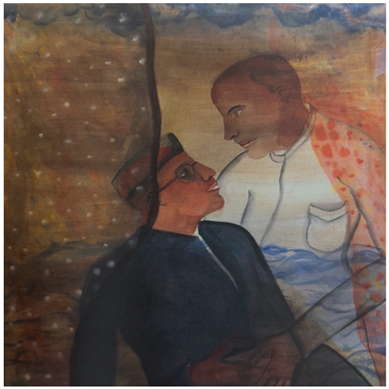
to be walking toward something within themselves, Figure 1. Thus, the city of Khakhar is also mental
and emotional. But to say that only Khakhar created a new consciousness of the
Indian city would not be entirely accurate. Such a thing makes him very lonely
and shows the significant change already underway in Indian art. Since the
middle of the twentieth century, many artists have been working seriously on
|
Figure 1
|
|
Figure 1 Khakhar. Bhupen. (2001). Embrace. Oil on Canvas |
|
Figure 2
|
|
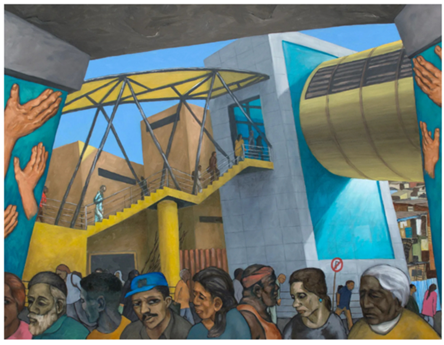
Figure 2 Patwardhan. Sudhir. (2024). In and out.
Oil on Canvas |
the changing
conditions of the city and modern life. Gieve Patel
carefully examined the common people, their bodies, and urban conditions.
Sudhir Patwardhan gave importance to subjects like the working class, labour,
transport and housing in painting, Figure 2. Nalini Malani worked on questions like
violence, displacement, sexuality and breakdown, which are deeply connected
with the realities of the modern city.
If we go further
back, then the work of artists like Ram Kumar and Bikash Bhattacharya is also
very important in understanding the urban experience. There is
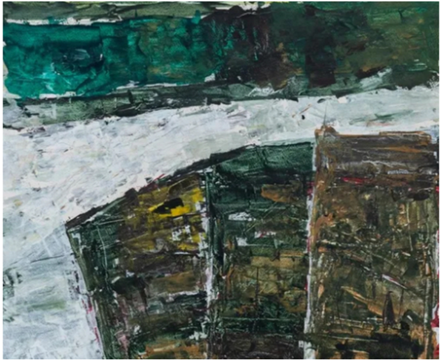
silence, emptiness and mental loneliness in Ram Kumar's cities, Figure 3.
They do not extend
the daily social life like Khakhar, but bring to the
fore the restlessness within the modern city. On the other hand, Bikash
Bhattacharya portrayed the harsh, restless truths of urban society with sharp
realism, especially in Kolkata. Therefore, it would not be right to call
Khakhar the only artist of urban consciousness. Rather, they should be seen as
a very different and important voice within that major artistic shift. His
biggest feature is that he connected the city with an autobiographical
experience. Here, the city becomes the place where social life and inner life
constantly clash and meet.
|
Figure 3
|
|
Figure 3 Kumar. Ram. (2016). Untitled. Acrylic on
Paper |
AUTOBIOGRAPHY AND SEXUALITY IN THE ART OF KHAKHAR
A very important
aspect of Bhupen Khakhar's art is its autobiographical nature. In his
paintings, it seems he is not only depicting the outside world,
but also including his inner experiences. For them, painting was not
just about entering outward things. He was also a means of understanding
his place in life, his relationships,
his identity, and society. This makes sexuality a more important theme in his
art. There was silence in Indian society about homosexuality for a long time.
He was not spoken openly, and he was not accepted socially. In such an
environment, Khakhar's quota of wishing in painting was an important artistic
and social step. He made the scene of what society often hides. The most
remarkable thing is that he did not use too many symbols or curved signs. He
showed intimacy and homosexual desire within the everyday world. This brings
out his paintings to the point that queer life is no different from, or outside
of, ordinary human life; he is present within ordinary human life. Nevertheless,
it would not be right to limit the entire art of Khakhar to sexuality only. His
paintings also convey equality, discomfort, social interaction, memory,
insecurity, and the complexity of everyday relationships. But it is also true
that sexuality is an important part of his autobiographical voice. The same
thing gives his art special honesty and also creates emotional risks in some
places. Some critics have tried to explain his pictorial qualities by linking
them to pre-Renaissance Western art, especially through his flatness, narrativeness, and straightforward structure. This
comparison can be useful to some extent, but if this is fully understood, then
the matter will remain incomplete. Khakhar's paintings are deeply rooted in
Indian life—the inner world of the house, the relations of the locality, body
postures, visual disorder, and the social environment in which people
constantly see and test each other. Therefore, his style should not be
understood as a copy, but as a conversion. Even if there were external
influences, they used them by adapting to their experience and surroundings.
This is why their visual language seems private, local, and lived.
THE CONCEPT OF COMPASSION
Bhupen Khakhar is
often described as a compassionate artist. This observation seems valid to a
certain extent, as many of his paintings draw attention to individuals who
appear solitary, vulnerable, insecure, or socially ill at ease. He depicts
ordinary life without either mockery or contrived sentimentality. There is
often a palpable warmth in his gaze. He does not cast his subjects as heroes,
yet he accords them dignity. Perhaps this is why his art resonates so
profoundly with so many people. In his work, ordinary life never appears
diminished.
Nevertheless, it
is somewhat difficult to assert that he was the “the most compassionate”
artist. Compassion is not a quality that can be precisely quantified; it
depends, in part, on the viewer's own experience. While one individual might
perceive the greatest depth of compassion in Khakhar’s paintings, another might
find that same sensibility more evident in the work of Gieve
Patel, Sudhir Patwardhan, or Nalini Malani.
There is another
consideration as well: compassion “towards whom”? Towards queer lives? Towards
middle-class existence? Or towards those whom society frequently overlooks?
Until this is clarified, the term remains somewhat open-ended and ambiguous.
Therefore, it would be a more balanced assessment to say that Khakhar’s art
“evokes” compassion, rather than to declare him the “most compassionate” artist
categorically.
PUBLIC RECEPTION AND THE QUESTION OF “CONTROVERSY”
A significant
question regarding Khakhar’s art concerns how it was received by society,
particularly in the context of his sexuality. It is sometimes argued that,
precisely because he was open about his identity, he managed to avoid
controversy or undue prurient curiosity. However, this view oversimplifies the
matter.
The public
reception of art is never determined by a single factor alone. It is shaped by
a complex interplay of social class, cultural networks, galleries, critics,
institutions, and the sheer reach- the number of people- that a particular work
touches. A person's candour or openness can certainly have an impact, but it
does not necessarily eliminate all sources of tension. At times, such openness
can even heighten risks. Therefore, it would be incorrect to assume that
Khakhar was spared from any discomfort simply because he was forthright about
his identity. The term “controversy” itself must be interpreted with nuance.
His paintings- which depicted male intimacy and same-sex desire- were
undoubtedly distinct within the social milieu of his time and had the potential
to make people uncomfortable.
However, it is not
inevitable that this discomfort will always manifest as overt public
controversy. Quite often, such reactions take the form of silence, hesitation,
gossip, private opinion, or mild unease. A subdued reaction does not imply that
society has embraced the subject with complete ease. It is also worth noting
that such artworks often reach a limited audience- specifically, those within
the confines of galleries and the art world. Consequently, a lack of
significant reaction may, in many instances, reflect a restricted cultural
reach. For this very reason, the public reception of Khakhar's art must be
understood in a layered manner; it encompassed visibility, discomfort, and a
circumscribed cultural sphere.
DEMONSTRATION TRADITIONAL AND SEXUALITY
In discussions of
sexuality, old display forms are sometimes seen in relation to homosexuality,
especially where male artists played female roles. But such direct
manipulations sometimes create confusion. Historically, such traditions were
mostly made because the public participation of women was a social ban, not
because the sexual identity of the artists was the same. Therefore, it would
not be right to consider these traditions as a simple proof of homosexuality.
Doing so weakens historical understanding. In the context of Khakhar, it would
be more appropriate to pay attention to the direct and conscious forms of
sexuality that appear in his art.
WAS KHAKHAR A REVOLUTIONARY ?
Sometimes Khakhar
is remembered in very grand terms, as if he were a revolutionary in some broad
political sense. This comparison comes with respect, but sometimes it becomes
too much. Political revolution and artistic change are not the same thing. Khakhar
did not change society through any mass movement. His contribution is in the
field of visual culture, representation and artistic imagination. But that
doesn't mean he had little influence on art. He changed what could be depicted
in the painting, and what experiences could find a respectable place there,
especially in terms of urban life, personal feelings, and queer identity. So if he is called “revolutionary”, then he should be
understood in the context of art and culture. They were important because they
expanded the possibilities of Indian painting and opened the way for
experiences rarely seen before.
CONCLUSION
In conclusion, it
can be said that Bhupen Khakhar was an artist of modern Indian art who did not
allow painting to remain merely an object of visual consumption,
but rather transformed it into a medium for lived experience. His
greatest distinction lies in the way he seamlessly interweaves the ordinary
life of the city, personal emotions, solitude, desire, social unease, and queer
identity- rendering each equally significant within the realm of art. In his
work, the city is not merely a visual tableau of streets, houses, and people;
it is an emotional and human universe where the individual navigates their
inner conflicts, relationships, memories, and societal pressures.
Bhupen Khakhar’s
art is also exceptional because he gave visual form to experiences that society
often maintains silence about. Homosexuality, male intimacy, personal truths,
and inner restlessness- he accorded space to all these themes in his paintings without
any unnecessary concealment. This was not merely an act of artistic audacity,
but also a profound human intervention. He demonstrated that private life- no
matter how uncomfortable, unspoken, or socially unacceptable it might be
deemed- can nonetheless serve as a valid and serious subject for art. At the
same time, a sense of balance is equally essential when seeking to understand
Khakhar. To pigeonhole him solely as an artist of urban consciousness, or to
confine him within static descriptors such as “the most compassionate,” serves
only to diminish the true depth of his art. He was part of a broader artistic
transformation, a milieu in which other artists were also engaging seriously
with themes of the city, society, insecurity, labour, violence, and the
spectrum of human experience. Yet, within this expansive landscape, Khakhar’s
identity stands out as distinct and enduring precisely because he bridged- with
remarkable honesty- the divide between the public and the private, the social
and the personal, the external and the internal. His art also teaches us that
society’s reactions are rarely straightforward or unambiguous. Visibility does
not invariably equate to acceptance, nor does silence necessarily signify
consent. Khakhar’s paintings operate within this complex terrain- a space where
presence, discomfort, sensitivity, and resistance coexist. Perhaps this is the
very reason why his art, even today, does not remain merely a relic of history,
but continues to pose questions to us in the contemporary moment.
Thus, the
significance of Bhupen Khakhar’s art lies not solely in ‘what’ he depicted, but
equally in the extent to which he rendered Indian art more humane, personal,
and truthful. He imbued ordinary life with dignity, gave visibility to personal
experience, and demonstrated that art’s deepest connection ultimately lies with
the inner truth of the human being. This is precisely why Bhupen Khakhar
remains relevant today- and why his art continues to compel us not only to
look, but also to think and to feel.
ACKNOWLEDGMENTS
None.
REFERENCES
Brown, R. M. (2009). Art for a Modern India, 1947-1980. Duke University Press. https://doi.org/10.1215/9780822392262
Dercon,
C., and Raza, N. (2016). Bhupen Khakhar:
You Can't Please All. Tate Publishing.
Hyman,
T. (1998). Bhupen Khakhar. Mapin Publishing.
Kapur,
G. (2000). When Was Modernism: Essays on Contemporary
Cultural Practice in India. Tulika Books.
Kapur, G. (2007). The Uncommon Universe of Bhupen Khakhar. In K. Mercer, Pop Art and Vernacular Cultures (110–135). MIT Press and InIVA.
Khullar, S. (2015). Worldly Affiliations: Artistic Practice, National Identity, and Modernism in India, 1930-1990. University of California Press. https://doi.org/10.1525/9780520356054
Zitzewitz, K. (2009). The Moral Economy of the Street: The Bombay Paintings of Gieve Patel and Sudhir Patwardhan. Third Text, 23(2), 151–163. https://doi.org/10.1080/09528820902840623
Kapur, G. (2006). Gender Mobility: Through the Lens of Five Women Artists in India [Lecture text]. Faculty of Fine Arts, M. S. University of Baroda.
|
|
 This work is licensed under a: Creative Commons Attribution 4.0 International License
© ShodhShreejan 2026. All Rights Reserved.