|
|
|
|
Original Article
ART AND CONTEMPORANEITY: CRIATIVE PERFORMANCE AND EXPRESSIVENESS OF THE ARTIST
|
Ilda Maria
Afonso Monteiro 1* 1 Researcher,
Visual Artist and Writer, Polytechnic Institute of Viseu School of Education,
Center for Studies in Education, Technologies, and
Health (CI&DETS) and Av. Cor. José Maria Vale De Andrade Polytechnic
Campus 3504 – 510, Viseu, Portugal |
|
|
|
ABSTRACT |
||
|
This research focuses on an approach to contemporary art within the field of artistic expression, characterised by the use of everyday materials and a diversity of visual languages, which convey messages that relate to art as lived experiences. The main objective of this study is to establish the framework of contemporary art at the central intersection of culture, society and the individual. From a methodological perspective, it offers an innovative view of the world, allowing not only aesthetic representation but also critical reflection on the surrounding reality in which it is embedded. It is evident that contemporary art has, over time, evolved and incorporated conceptual transformations into the most varied forms of image construction, assuming multiple contexts and meanings on a global scale. In summary, this study aims to understand how contemporary art functions simultaneously as a form of aesthetic expression and as an instrument of critical inquiry, capable of revealing, problematising and reconfiguring the social, cultural and symbolic dynamics that structure human experience in the contemporary context. Keywords: Contemporary Art, Artistic Expression, Artistic
Movements, Socialisation, Creative Performance |
||
INTRODUCTION
Art has been a form of expression since the dawn of humanity. Fischer
(1987) states, “art has existed since prehistoric times”,
whilst Duarte
Júnior (1994) adds, “art has
coexisted with humanity since the beginning of its existence”.
For Buoro
(2000), “art is vital” and
its production reflects the historical development of humanity, being
considered an integral part of the cultural events of each era Buoro
(2000). In the prehistoric
context, the primary function of art was not to convey “beauty”, but to serve
as a means of survival, representing collective beliefs, values and customs Fischer
(1987). Coli (1989) observed that art performed social and economic
functions, whilst Ledur
(2005) asserts that the work was always created by the
artist. Despite this, Barbosa (1990) emphasises
that “art does not depend on culture”, suggesting constant renewal. The
National Curriculum Parameters PCNs (2001) emphasise that “art teaches”,
reinforcing Fischer
(1987) view that “art is part of the history of humanity”.
It is evident that contemporary art enables us to understand the evolution
of the visual arts, as demonstrated by avant-garde artists such as Duchamp,
whose use of the ready-made and works such as Bottle Dryer Schwar, (2000), Vidal
(2012).
These artists marked a shift in the aesthetic and conceptual perception of
art, transforming symbolic-formal language into expression.
Reflecting on the subject, we can conclude that contemporary art has always
been an integral part of culture, gaining ever-greater autonomy and reaffirming
itself as a practice of dialogue within the historical, social and aesthetic
context in which it is embedded.
PROBLEM
STARTING POINTS
The theme of
contemporary art and its relationship with the artist in environmental terms
was a key factor in the development of this research.
Following this
challenge, it was necessary to formulate a series of questions:
·
From an
ideological point of view, what is the status of the artist from an aesthetic,
philosophical, moral and social perspective?
·
What are
the benefits of contemporary art in environmental terms?
·
What is
the impact of this type of art on the contemporary world?
·
What are
the potentials and limitations of the images produced by contemporary artists
in the interpretation and understanding of the human being?
The research
adopts a critical approach and, above all, one that is sensitive to the art
forms studied here, focusing on the uncertainty and expectations of life in the
world.
From this
perspective, the research analyses the artistic forms under study, exploring
the relationship between artistic creation, cultural perception and social
reflection.
STATE OF THE ART
AESTHETIC CANONS IN CONTEMPORARY
Contemporary art
is defined by its artistic avant-garde, styles, and techniques, fighting
against traditionalism in art across various social, political, and
technological contexts, among others.
Artists such as
Yayoi Kusama have developed immersive installations that allow the public to
engage with the artwork interactively, as observers within the artistic
practice.
At the same time,
digital platforms have emerged as strategic tools for the dissemination,
appreciation and commercialisation of works in the virtual space, strengthening
the contemporary art market. Following the Second World War (1939–1945), there
was an evolution in globalisation, mass culture and technology, favouring new
forms of artistic expression, such as performances, happenings, installations
and video art.
According to Rougé (2003), in contemporary art “the classical is
replaced by mixed media and multimedia”, whilst Archer
(2001) highlights that contemporary art “has taken
on different forms and names”, incorporating the “use of communication
technologies” as an integral part of artistic practice. Furthermore, according
to Archer
(2001), aesthetic approaches emerged focused on
social criticism, the appropriation and modification of objects, marking a
break with modernism.
According to Cauquelin
(2005), contemporary artistic production is
characterised by large-scale works, albeit lacking traditional aesthetic
qualities; formal aspects such as colours, formats and figurative
representations, whilst conceptual art takes centre stage in the Duchampian era,
in which artistic activity moves away from classical aesthetics, emphasising
concepts such as singularity, genius and the specificity of the reality
depicted. According to the author (2005, p. 80), “contemporary art retains aesthetic
characteristics of practices that ‘put the artist at risk’” Cauquelin
(2005). Thus, contemporary art prioritises
creativity and innovation over formal technique, utilising new media and
communication strategies Archer
(2001). Fusari and Ferraz (1993, p. 105) emphasise that “the
purpose of the work of art stems from communication with the universe”,
reinforcing the relational, critical and conceptual dimensions of artistic
production.
METODHODOLY
From a theoretical perspective, the aim of this research falls within
my area of interest regarding the artistic experience, seeking to understand
the concepts and practices of contemporary art. From a methodological
perspective, the contextualised theme links theoretical foundations with a
critical analysis of current artistic expressions. To carry out this work,
specific bibliographic research on the subject was required to enable the
collection of information, the identification of schools of thought, and the
establishment of artistic concepts across different approaches.
This research provided the basis for developing the theme through
practical and theoretical questions aimed at understanding contemporary art
within an interdisciplinary framework, the analysis of which contributes to
reflection on artistic creation, reception, public acceptance and its
integration into contemporary social, cultural and technological contexts.
HISTORICAL CONTEXT
COMPLEXITY AND NATURE OF THE ARTISTIC FIELD
Over the past five
decades, numerous critics, theorists, artists and researchers have made
significant contributions to defining and examining the concept of contemporary
art, highlighting the complexity and nature of this artistic field. Between
1945 and 1960, movements such as art brut, expressionism and abstractionism
emerged which, by challenging the prevailing aesthetic and formal canons,
created the conditions for the development of contemporary art as an autonomous
paradigm.
This period is
characterised by a progressive break with traditional models of art, opening
the way for a multitude of experiments with new artistic languages, materials
and practices.
The
transformations that began at that time are evident, for example, in works that
make use of unconventional materials and strategies for appropriating iconic
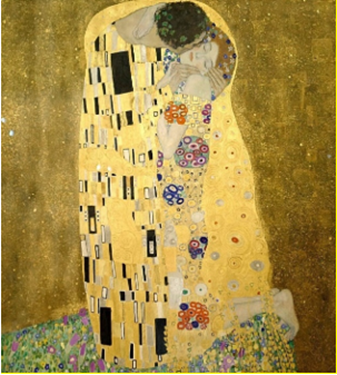
images from art history. The large-scale photographic recreation of Gustav
Klimt is The Kiss Figure 1, produced from waste materials, constitutes
a paradigmatic example of this redefinition of theconcept
of the work of art, emphasising the departure from traditional materiality and
the emphasis on the conceptual process.
|
Figure 1 |
|
|
|
Figure 1 Gustav Klimt’s
Kiss |
Rush (2006) identifies the historical antecedents of the art installation in
Renaissance churches, where altarpieces — composed of painted images integrated
into wooden architectural structures — were designed for public enjoyment and
an integrated spatial experience (p. 33). In turn, Pontual (1987) establishes a relationship between
contemporary art and Mannerism, highlighting multiplicity and a lack of harmony
as characteristics common to both artistic contexts (pp. 27–28).
From this
perspective, Archer
(2001) describes how contemporary artistic
production emerged from fragmentation, leading the artist to resort to the
recombination of distinct elements as a creative strategy (pp. 155–156).
For Thistlewood
(2005), contemporary art results from experimental
practices deeply marked by the incorporation of new technologies, attributing
to the artist an active role in social, political, economic and cultural
contexts (p. 116). Artistic practice thus takes on a predominantly conceptual
character, with less technical skill
and a greater capacity for critical reflection. In this context, Cauquelin
(2005) observes that many contemporary artists draw
inspiration from Duchampian concerns, within a system that simultaneously
values the figure of the artist and the institutional legitimisation of art (p. 116).
Consequently,
traditional artisanship and aesthetics may become secondary or even irrelevant
within the artistic field Cauquelin
(2005).
Bourriaud
(2009) adds that these practices contribute to the
problematisation of classical models of production and consumption of the
artwork, leading to the dilution of the notions of originality and creation (p. 8). At the same time, the
exhibition space expands and takes on a multifaceted and flexible character,
intertwined with the artwork itself.
According to Cauquelin
(2005), the space of contemporary art is not
restricted solely to museums or galleries, as it possesses a system of codes
that favours the internationalisation of the artist and the mobility of the
works (p. 120). However, in other artistic movements,
contemporary art critically reflects its historical era Archer
(2001).
In a context
marked by globalisation, this art form promotes sharing and dialogue between
different cultures, contributing to the reconfiguration of contemporary
artistic practices Archer
(2001). For Thistlewood
(2005), contemporary art holds value by producing
critical and challenging effects on current culture (p. 117).
Finally, Rougé (2003) emphasises that every historical period has
its own contemporary art, with artists’ work being essentially speculative in
nature, through a critical interpretation of aesthetic, cultural and
ideological meaning.
CONTEMPORARY ART MOVEMENTS / POLITICAL AND CULTURAL
INFLUENCE
Contemporary art
movements develop within a context marked by political, social and cultural
transformations, reflecting the tensions and discourses of their time. Among
the major movements are Abstract Expressionism, Pop Art, Conceptual Art,
Minimalism, Post-Minimalism and Neo-Expressionism, each revealing different
forms of critical engagement with historical reality.
Abstract
Expressionism emerged in the post-World War II period, characterised by a
gestural, subjective and emotional approach, in contrast to figurative
traditions. Jackson Pollock and Mark Rothko, as central figures of this
movement, explored action, scale and expressiveness during a period marked by
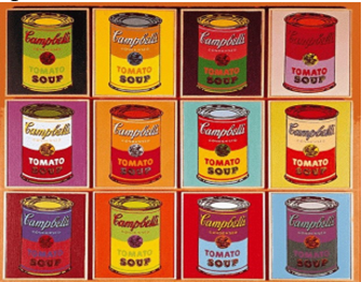
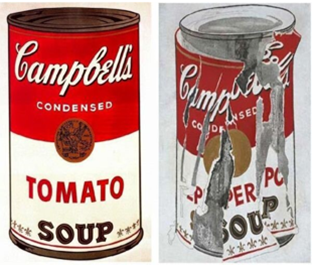
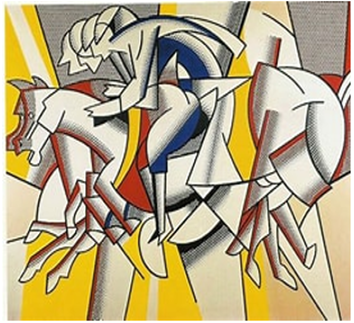
political and existential instability. Pop Art emerged as a critical response
to mass culture and consumerism, appropriating images from advertising, the
media and everyday life,
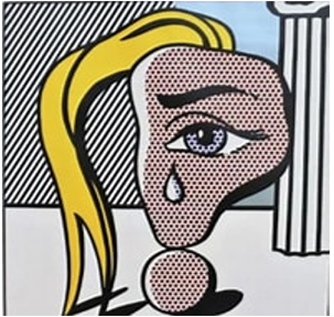
Andy Warhol Figure 2 and Figure 3 Roy Lichtenstein Figure 4 and Figure 5.
|
Figure 2 |
|
|
|
Figure 2 Colored
Campbell’s Soup Cans (1965) |
|
Figure 3 |
|
|
|
Figure 3 Campbell’s Tomato
Soup Can Campbell (1968) |
|
Figure 4 |
|
|
|
Figure 4 It, S About
Time: (1923) (1923) |
|
Figure 5 |
|
|
|
Figure 5 Muchacha Con Lágrima
III (1977) |
Notable features
include screen printing and the repetition of vivid colours, transforming
commercial products and public figures into works of art. Thus, contemporary
art plays a reflective and critical role, questioning social, political and
cultural norms through visual language.
In the development
of conceptual art, this trend intensified in the 1960s and 1970s, with the aim
of emphasising the artistic object. Artists such as Joseph Kosuth and Yoko Ono
used their works to question power, war, civil rights and economic crises, as
well as ideology and personal values,
in their artistic practice.
When it first
emerged, contemporary art was widely contested for breaking with established
artistic norms; however, over time, it has gradually become integrated into
mainstream culture and the institutional art world.
POP ART
The emergence of
Pop Art in the 1950s marked a significant transformation in artistic
production, incorporating direct references to the world of consumerism and
popular culture. The themes addressed reflect American social reality,
represented by everyday objects such as Coca-Cola bottles, industrial packaging
and images taken from newspapers. According to Archer
(2001), “in Pop Art themes, banality defied the
critics”, as ordinary objects came to assume artistic status.
The use of
techniques such as screen printing and photography was associated with intense
colours and repetition, particularly evident in the work of Andy Warhol. For Cauquelin
(2005), Warhol “abandoned traditional aesthetics”,
renounced “handcrafted skill” and distanced art from classical notions of
taste, beauty and uniqueness, establishing an incompatibility between technical
alienation and authorial hyper-personalisation.
MINIMALISM
Minimalism is
characterised by formal reduction and an emphasis on the relationship between
the artwork, the space and the viewer. This movement makes use of various
industrial materials and emphasises the physical presence of the artwork within
the exhibition space. According to Archer
(2001), it is a practice that does not reject figuration, but uses it in an allusive manner. Frank Stella Archer
(2001) states that Minimalist art is not
speculative, but direct: “it is what one sees”, attributing to the artist a
role as mediator between object and perception.
POST-MINIMALISM
Post-Minimalism
emerged as a critical development of Minimalism, incorporating greater formal
flexibility and the use of communication technologies. This period is
characterised by a multiplicity of artistic languages and practices. Artworks
are now frequently produced with the assistance of other professionals, in
accordance with the artist’s conceptual requirements and market fluctuations,
thereby reinforcing the processual dimension of artistic creation.
CONCEPTUAL ART
In the 1970s, the
dematerialisation of the artwork intensified, becoming increasingly free in
both thematic and technical terms. For Danto
(2006), ‘viewing a work of art’ implies an
experience focused on ‘materialisation and interpretation’. In this context, Brito (1980, p. 85) identifies
a transformation in artistic thought, associated with a process of
“celebration”. Cauquelin
(2005) emphasises that in conceptual art, little
importance is attached to the nature of materials, exhibition requirements or
creative spaces.
Artists utilize
documentation, visual and auditory means, employing landscape elements, often
on a large scale. According to Cauquelin
(2005), these works allow the viewer to become a
co-author, particularly during the Duchampian period.
The installation
is not understood as traditional
sculpture, since the exhibition forms part of the work itself Rougé (2003). This practice is developed by artists such
as Joseph Beuys, Katharina Fritsch, Louise Bourgeois, Martin Kippenberger,
Annette Messager and Judy Chicago. In this context, the artist acquires
conceptual freedom, taking on a ‘life of its own’ as a creative agent Archer
(2001).
Finally,
performance art and body art draw on a variety of artistic languages, in which
the audience becomes an integral part of the work Rougé (2003). According to the author (2003, p. 36), body art
artists challenged the prevailing attitudes of their time, using the body as a
political, social and symbolic space of resistance.
CHARACTERISTICS AND EXPRESSIVE ELEMENTS OF
CONTEMPORARY ART
The most important feature of contemporary art stems
from the practice of creating works of art based on political or religious
ideologies. Artists of the 20th century sought to redefine the meaning of art
and the
term ‘avant-garde’, applied to contemporary art in terms of
what is original and modern,
Marcel Duchamp with utilitarian
pieces.
In the 1950s and 1960s, Allan Kaprow approprieted his own body in artistic performances, and in the
1970s, the American artist Robert Smithson with his earthwork style. A large
number of 20th-century artists, such as Grant Wood with his American Gothic
style, rejected avant-garde art in favour of modern technology. At the same
time, Pablo Picasso incorporated a new collage technique into his works, using
newspaper clippings and other printed materials.
The artists Henri Matisse and
Paul Klee drew inspiration from children’s drawings; Picasso by African masks;
and Pollock drew inspiration from the sand paintings of North American Indians
in his technique of splashing paint onto the canvas, as did Andy Warhol in his
depiction of Campbell’s soup cans. The most important characteristic of
contemporary art is the attempt to create works of art without institutional
support, in order to imbue their works with personal meaning and originality.
As a contemporary form of
expression, the installation—a reflection of our times—enables viewers to
experience different sensations, some more interesting than others. The viewer
collaborates with and interprets the artwork, which makes it difficult to define
contemporary art. Contemporary art thus establishes itself as an autonomous
field of symbolic experiences, in which the multiplicity of languages, media
and interpretations reflects the complexity of artistic thought and its
meanings within the contemporary socio-cultural context.
STATUS AND
SOCIALISATION IN CONTEMPORARY ART
In contemporary art, the artist’s
transgression manifests itself in the very status of the proposed object,
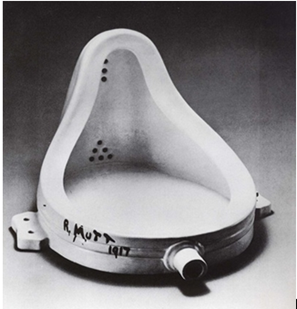
raising a sociological issue within the art world. The paradigmatic example of
Marcel Duchamp’s Fountain Figure 6, dating from
the First World War period, establishes a new aesthetic regime in which
contemporary art history of traditional art as an affirmation of an aesthetic
category centred on meaning and context, not merely on the exhibited object —
in this case, a urinal presented at the Salon des Indépendants.
According to Buren, the work of art results from the reorganisation of the
environment as an ‘outil visuel’,
shifting the focus from the materiality of the object to the relationship it
establishes with the exhibition space. This perspective finds echoes in Gestalt
psychology, whose experiments on visual perception demonstrate that the
observer perceives the exhibited pieces as well as the environment in which
they are situated. Such perception helps to understand the reactions of
rejection and the symbolic protests directed at public institutions on behalf
of the artistic and social community Heinich (1998b). In this
paradigmatic context, the public’s difficulty in recognising certain works
highlights the rupture with the traditional criteria of aesthetic legitimacy
that characterise contemporary art. According to Buoro
(2000), art “consists of revealing to the public the relationships between human
beings and nature and” (p. 23), highlighting the mediating role
between the individual and the social environment of each era. Coli (1989) argues that the
artist evolves in tandem with technological and social transformations through
different ‘phases’ that influence artistic expression (p. 27).
|
Figure 6 |
|
|
|
Figure 6 Fountain by Marcel Duchamp |
The author also notes that the
very notion of art is not universal, as it depends on the specific cultural
context in which it develops Coli (1989). This statement reinforces the idea that art must draw upon historical,
social and symbolic conditions. In the contemporary era, Fischer
(1987) attributes a transformative
function to art, asserting that it is capable of bringing about changes in
social attitudes (p. 231).
In a world marked by
globalisation and profound cultural transformations, human beings are engaged
in a constant process of exploring forms of expression. In this context, the
artist embraces creative freedom, regarded as an essential tool for conveying their
critical and interventionist engagement with society. Thus, for Fischer
(1987), art represents an expression of its own social function, insofar as it
reflects, questions and intervenes in reality.
ARTISTIC AND SOCIAL RELATIONSHIPS IN CONTEMPORARY ART
The relationship between art and
society, enabling us to understand art as a reflection of the political and
social. According to Bourdieu, the artistic sphere exerts an effect of
restructuring or retracting social forces, in the face of specific rules Furió (2000). However, institutions do not interact
directly with artistic production, which implies that “artistic and social
relations are indirectly linked” Furió (2000). This
perspective allows us to understand the autonomy of art in the face of social,
political and economic pressures; as a form of social expression, it manifests
itself through the diversity of styles, forms, materials and themes that
characterise the different periods of art history.
Throughout history, art has
played a fundamental role in religious expression, as evidenced by the temples
and mosques of the Islamic world, as well as the mosaics and Gothic
stained-glass windows of Western cathedrals. Society’s interpretation of a work
of art always takes place within a specific historical and social context, in
which it is, attributed a symbolic and intervening value. Paradigmatic examples
include the Statue of Liberty in New York, as a symbol of the ideals of freedom
and democracy, or the iconography of political power, such as the imperial
eagle in the Bundestag or the architecture of Versailles, which reinforces the
idea of the State centralised during the reign of Louis XIV.
The power of art lies in its
ability to express social trends through specific political ideals. In
totalitarian contexts, artistic production tends to exploited,
as art can serve as a means of protest and ideological resistance. In this
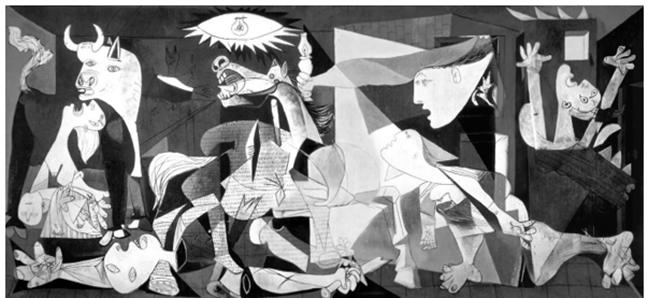
sense, Pablo Picasso’s Guernica Figure 7 is an emblematic example of art’s critical function, expressing the
artist’s solidarity with the Republicans during the Spanish Civil War, inspired
by the bombing of the Basque town of Guernica.
The work highlights art’s capacity to denounce violence and mobilise Pablo Picasso’s Guernica (1937) does not directly depict the historical event that inspired it, but evokes, through the images and forms adopted by the artist, the agony and violence inherent in war.
|
Figure 7 |
|
|
|
Figure 7 Guernica, 1937,
Pablo Picasso |
It is a vision of an almost
prophetic nature, anticipating the devastation caused by the carpet-bombing
that would come to characterise the Second World War.
The work does not merely narrate
a specific event, but a symbolic reality that intensifies the experience of
human suffering. Reality, understood in an ontological sense, is unique,
objective and concrete; however, what we refer to as society constitutes a
diversity of situations, individuals and diverse practices. The social structure encompasses
religious beliefs and practices, markets, political actions, culture and
conceptions of art. In this way, the visions, perspectives and modes of
artistic interpretation of reality give rise to heterogeneous, socially and
culturally coded symbolic realities. The artist assumes the role of interpreter
of the community to which they belong, through sensitivity and thought, and
through individual and collective experiences. The very concept of ‘art’ is
diverse; the very concept of ‘art’ embodies diversity, giving rise to multiple artistic
languages, techniques and materials that characterise the works. From the interplay between social reality and
the thoughts that drive the artist—as a symbolic and expressive synthesis—other
perspectives for analysing the relation ship between
art and society may be considered, as a sublimation of existence living rise to
multiple artistic languages, techniques and materials that characterise the
works.
Aesthetic norms tend to constrain
new forms of expression, often driven by critics, whose views can influence the
public’s acceptance of works. A case
that has become paradigmatic is that of Édouard
Manet (1832–1883), a recognised pioneer of modern
painting, whose many works rejected in the 19th century are
now exhibited in the world’s most important museums Furió (2000). In
contemporary capitalist societies, access to the artistic field is increasingly
restricted to specific social groups possessing the economic capital to secure
prestigious aesthetic legitimacy. According to Herbert Read, “no one will deny
the profound interrelationships between the artist and the community. The
artist depends on the community” Read (1968). However, Read asks: if art were
merely a product of external qualifications, how could one explain the
similarities between works belonging to different historical periods? Read (1968). From this perspective, the
artist perceives, shapes cultural patterns and defines their aesthetic
perception, transforming it into artistic language.
A CHRONOLOGICAL
OVERVIEW OF CONTEMPORARY ART
The period following the Second
World War marked a turning point in the redefinition of Western artistic
practice. Between 1945 and 1960, movements such as Art Brut, Abstract
Expressionism and Abstract Art emerged, bringing about a break with the aesthetic,
formal and institutional conventions of modern art. These movements valued
subjectivity, spontaneity and experimentation with new materials, paving the
way for the emergence of contemporary art.
Movements such as conceptual art,
performance art, land art, happenings and installations contributed to the
dematerialisation of the artistic object and to the prioritisation of concept
over form. According to Cauquelin
(2005), it was a period deeply influenced by Duchampian concerns regarding
authorship, originality and aesthetic value.
The artist takes on a critical
and interventionist role, often linked to social, political and cultural
issues, whilst the museum and the gallery cease to be the only legitimate
spaces for art.
The 1980s and 1990s are
characterised by a rich diversity of artistic languages and the fragmentation
of aesthetic discourses. During this period, there was a return to painting,
particularly through neo-expressionism and figurative painting, which re-emphasised
the expressiveness, subjectivity and materiality of the work. According to Dempsey
(2003),
Neo-Expressionism by its emotional intensity and expressive exploration of
materials, whilst Cauquelin
(2005) associates
this trend with the affirmation of individual expression and the incorporation
of references to popular culture. At the same time, Archer
(2001) observes a transformation between art and public space, marked by the loss
of the traditional aesthetic concept and its replacement by new artistic
interventions. Currently, contemporary art depends on the processes of
globalization, cultural mobility, and the integration of new technologies.The exhibition space extends beyond the museum
and the gallery, integrating urban spaces, digital platforms and hybrid
contexts. Artistic practice is becoming increasingly interdisciplinary, drawing
on installation, video, photography and digital media exploring issues related
to identity, the body, memory, consumption, politics and visual culture.
According to Bourriaud
(2009), these practices contribute to the redefinition of the notions of
authorship, originality and creation, promoting a relational and participatory
logic. Contemporary art thus asserts itself as an open field, in constant
transformation, capable of critically reflecting the social and cultural
dynamics of its time.
CONTEMPORARY ARTISTS
Contemporary artistic production is characterised by a diversity of
individual trajectories, by continuous experimentation with materials and
languages, and by a critical examination of social, cultural and political
realities. In this context, a number of artists stand out whose works reflect
the complexity of the contemporary world, bringing together conceptual,
symbolic and aesthetic dimensions.
1)
Carla
Filipe develops an artistic practice based on the use of multiple materials and
devices, establishing a direct relationship with popular culture, collective
memory and political activism. Her work challenges historical and social
narratives, questioning power structures and the processes of memory
construction.
2)
JULIÃO
SARMENTO creates work characterised by the fragmentation of the image and
narrative ambiguity, exploring themes such as desire, absence and
incompleteness. His visual discourse is characterised by a deliberate economy
of information, which invites the viewer to engage in an open interpretative
exercise.
3)
ADRIANA
MOLDER develops an interdisciplinary practice that brings together film,
drawing and literature, exploring the relationship between image, narrative and
subjectivity. Her practice reveals an intimate and reflective approach, centred
on the construction of visual worlds with a strong poetic charge.
4)
CATARINA
BOTELHO, in her artistic practice, reflects on materiality, memory and
timelessness, employing processes that highlight the permanence, transformation
and durability of materials over time.
5)
FERNANDA
FRAGATEIRO expresses herself predominantly through sculpture and installation,
exploring the relationship between space, architecture and perception. Her work
distinguished by a subtle and rigorous approach, in which the formal dimension
is closely with conceptual reflection.
6)
JOANA
VASCONCELOS uses sculpture and installation as her primary media to develop a
critical perspective on contemporary society, addressing issues such as
identity, gender, consumption and popular culture. Through the appropriation of
everyday objects and monumental scale, the artist subverts cultural and
aesthetic hierarchies.
7)
PAULA
REGO establishes a complex relationship between power, perversity and
narrative, frequently using the female figure as a central element of her
compositions. Her work revisits and reinterprets myths, traditional tales and
social structures, revealing latent tensions in human relationships.
8)
SANTIAGO
RIBEIRO develops work centred on installation, addressing contemporary issues
such as the human condition, spirituality and the tensions of today’s world.
His practice offers a critical reflection on the individual’s place in a
globalised and constantly changing context.
9)
VASCO
ARAÚJO structures his work around the deconstruction of historical, literary
and musical narratives, questioning identities, discourses of power and
cultural constructs. His work often takes on a performative and theatrical
dimension, inviting multiple levels of interpretation.
In his artistic practice,
10)
MIGUEL
PALMA explores the impact of technology on the life of contemporary man,
combining sculpture, installation and performance. His work reflects on the
relationship between technical progress, memory and utopia, revealing a
critical view of the promises of modernity.
FINAL CONSIDERATIONS
Contemporary art is characterised
by the absence of a dominant style, the use of multiple languages, and the
constant questioning of its own status. Throughout its chronological
development, a progressive shift can observed from the
object in a circumscribed space to an expanded space and from formal aesthetics
to critical observation. As Archer
(2001) describes, contemporary art carries historical time, playing an active
role in the construction of contemporary culture.
CONCLUSION
The analysis presented in this study highlights
the breadth and complexity of contemporary art, emphasising its ability to
foster interactivity, expressiveness and creativity. The artistic movements
examined — Abstract Expressionism, Pop Art, Conceptual Art, Minimal Art and
Neo-Expressionism — clearly reflect the social, political and technological
transformations of their respective eras, serving as vehicles for critical
reflection and the expression of ideas.
It is observed that the influence of culture and
politics on contemporary artistic production helps us understand how art
becomes an agent of social change, capable of questioning norms, values and
collective behaviours. At the same time, the incorporation of new technologies
has enabled interactive artistic experiences, in which the public is not merely
a spectator, but an active participant in constructing the meaning of the work.
Emblematic examples, such as Yayoi Kusama’s immersive installations, illustrate
how contemporary art breaks with the traditional paradigm, bringing artists and
the public closer together, and redefining the circulation and valuation of
works in the art market.
In this context, contemporary art prioritises
the idea, the concept and the attitude over the object or conventional
aesthetic form, establishing itself as a multidimensional practice that
encompasses painting, sculpture, performance, happenings, installations, video
art and other artistic languages. The transition from the industrial age to the
information and communication age has brought about significant changes in the
artistic field, promoting innovation, experimentation and the sharing of
artistic forms across different cultures and nations.
In summary, contemporary art constitutes a space
for dialogue between tradition and innovation, between the individual and
society, and between the artist and the public, functioning simultaneously as
an aesthetic expression, a critical tool and a platform for cultural
interaction.
This study demonstrates that understanding
contemporary practices requires an interdisciplinary approach, one that takes into account the historical, social and technological
contexts that shape both artistic production and public perception.
ACKNOWLEDGMENTS
None.
REFERENCES
Archer,
M. (2001). Contemporary Art: A Concise History. Martins Fontes.
Barbosa,
A. M. (1991). The
Image in Art Education: The 1980s and Beyond. Perspectiva/Iochpe.
Barbosa,
A. M. (2005). The
Image in Art Education. Perspectiva.
Bourriaud, N. (2009).
Relational Aesthetics.
Martins Fontes.
Buoro,
A. B. (2000). The
Gaze in the Making: An Experience of Teaching and Learning Art at School (4th ed.). Cortez.
Cauquelin, A. (2005).
Contemporary Art: An
Introduction. Martins.
Coli,
J. (1989). What is Art?
(10th ed.). Brasiliense.
Danto,
A. C. (2006). After the End of Art: Contemporary Art and the Limits of History.
Odysseus Editora.
Dempsey,
A. (2003). Art in
the Modern Era: A Guide to Styles, Schools and Movements. Harry N. Abrams.
Duarte
Júnior, J. F. (1994). Aesthetic Foundations of Education (3rd ed.).
Papirus.
Fischer,
E. (1987). The Necessity of Art (9th ed.).
Guanabara Koogan.
Furió,
V. (2000). Sociology of Art. Ediciones Cátedra.
Fuzari,
M. H., and Ferraz, M. H. (1993). Methodology of Art Education (2nd ed.). Cortez.
Heinich,
N. (1998a). The
Triple Game of Contemporary Art. Minuit.
Heinich,
N. (1998b). Contemporary Art Facing Rejection: Case Studies.
Jacqueline Chambon.
Ledur,
R. R. (2005). Contemporary Art Teachers: Contexts of Meaning
Making. Federal University of Rio Grande Do Sul.
Pontual,
R. (1987). Between Two Centuries:
20th-Century Brazilian Art. Gilberto Chateaubriand
Collection.
Rougé,
I. M. (2003). Contemporary Art. Inquérito.
Rush,
M. (2006). New
Media in Art. Martins Fontes.
Thistlewood, D. (2005). Contemporary Art and Education. In A. M. Barbosa (Ed.), Contemporary Art/Education (113–120). Cortez.
Vidal, C. (2012). Jeff Wall, Contemporary Art and Everyday Life. In J. V. Aguiar, J. T. Lopes, and N. Bastos (Eds.), Literature as a Sociological Object. Apenas Livro.
Biesdorf, R. (2012). Art, a Human Necessity: Social and Educational Function. Academia.edu.
Faria, R. O. (2019). Self-Representation and Contemporary Art: Identity, Otherness, Materials and Memories. Universidade de Lisboa Repository.
Nascimento, E. de N. (2013). Discourses and Reflexivity: A Study on the Musealization of Contemporary Art [Author’s Edition].
|
|
 This work is licensed under a: Creative Commons Attribution 4.0 International License
© ShodhShreejan 2026. All Rights Reserved.